Opening a brokerage firm is a massive undertaking. It’s not just about having a slick trading app or a solid marketing strategy; it’s about navigating a complex web of legal hurdles and global regulations. If you want to handle client money and trade stocks, Forex, or commodities, you need a brokerage license.
Think of this license as your “proof of entry.” It tells your clients, your bank, and the government that you’ve been vetted and that you’re committed to protecting investor funds. While the process can feel overwhelming, breaking it down into manageable steps makes the mountain much easier to climb.
Steps to Obtain a Brokerage License
- Determine Your Business Structure
- Choose the Appropriate Jurisdiction
- Meet Capital Requirements
- Prepare Necessary Documentation
- Fulfill “Fit and Proper” Criteria
- Submit the Application
- Undergo Regulatory Review
- Obtain the License
1. Determine Your Business Structure
Before you talk to a regulator, you need to decide what kind of “legal person” your business will be. This choice isn’t just paperwork; it dictates how much tax you pay, who is responsible if the business fails, and how you can raise money later.
The most common choices are Corporations and Limited Liability Companies (LLCs).
- Corporations: Excellent for raising venture capital or going public, but often come with “double taxation” on dividends.
- LLCs: Popular for smaller, leaner teams. They offer “pass-through” taxation, where profits are taxed as personal income, simplifying the tax bill.
Expert Insight: “Don’t just look at the tax benefits. Think about your exit strategy. If you plan to sell the brokerage or bring in institutional partners, a Corporate structure is almost always preferred because it makes the legal transfer of shares much cleaner than an LLC.”
2. Choose the Appropriate Jurisdiction
This is your most critical decision. Where you apply determines your reputation, costs, and which clients you can legally sign up.
You have to find the “sweet spot” between Reputation and Accessibility. A license from the UK (FCA) is a powerful marketing tool but requires millions in capital. An offshore license in a place like Vanuatu is cheap and fast, but you might find it harder to open a corporate bank account with one.
3. Meet Capital Requirements
Regulators want to know you won’t disappear if the market has a bad day. They mandate a Minimum Capital Requirement – cash that must sit in a bank account, untouchable for daily expenses like rent or salaries.
- Tier-1 (UK/USA): Can require anywhere from $125,000 to $20 million.
- Offshore (Seychelles/Mauritius): Often ranges from $25,000 to $50,000. You must provide audited statements proving this money is yours and comes from legal sources.
4. Prepare Necessary Documentation
This is where most people get bogged down. You must prove you are a professional firm, not just “a guy with a website.” Your package will usually include:
- A 3-5 Year Business Plan: Detailing projections and revenue models.
- AML/KYC Policies: Strict protocols for verifying client identities and spotting money laundering.
- Risk Management Policy: How you handle market volatility and cyber threats.
Expert Insight: “Regulators can smell a ‘templated’ manual a mile away. If your AML policy looks like a copy-paste job from the internet, they will reject you. Tailor your manuals to your specific technology and target market to show you actually understand the risks.”
You may also like


Vitaly Makarenko
January 17, 2024
5. Fulfill “Fit and Proper” Criteria
A brokerage is only as trustworthy as the people running it. Regulators will perform deep background checks on directors and owners, looking for:
Financial Soundness: They check personal credit scores to ensure owners aren’t under extreme financial pressure.
Integrity: Clean criminal records and no history of financial fraud.
Competence: A proven track record in finance. If your leadership has zero industry experience, the license will likely be denied.
6. Submit the Application
Once you have your mountain of paperwork, it’s time to file. But this isn’t as simple as hitting “send” on an email. Most regulators now use sophisticated online portals (like the Connect portal in the UK) that require you to upload documents in a very specific order.
Designating Your Point Person: You’ll need to name a “Principal User” or “Compliance Officer” who will be the regulator’s sole contact. This person needs to be incredibly organized because the regulator will expect immediate responses once the clock starts.
The “Final Polish”: Before you submit, have a third-party consultant or a legal team perform a “mock audit.” They will look for the small things that trigger an automatic rejection: an ID that expires in two weeks, a bank statement that is 91 days old (when the limit is 90), or a missing witness signature on a deed.
The Non-Refundable Entry Fee: You will be required to pay an application fee upfront. These aren’t cheap – depending on the country, they can range from $2,500 to $25,000+. If your application is rejected because you forgot a document, you usually don’t get this money back.
7. Undergo Regulatory Review
This is the “waiting room” phase, and it’s often the most stressful part. For the first few weeks, the regulator will just check if your application is “complete.” Once they confirm you aren’t missing any pages, the real “Inquisition” begins.
The Clarification Loop: Expect to receive “Section 166” style requests (or the local equivalent). These are formal letters asking for more info.
The Deep Dive: A dedicated case officer will be assigned to you. They will scrutinize your business plan to see if your profit projections are realistic or if you’re being too “optimistic.” They will look at your “Close Links” – essentially checking if any of your business partners or parent companies have a shady past.
The Management Interview: In many jurisdictions, the regulator will call your Directors and Compliance Officer in for an interview. They won’t ask about your marketing; they will ask hard questions about risk mitigation and conflict of interest. They want to see if your team actually understands the manuals you submitted or if you just hired a consultant to write them for you.
Expert Insight: “Speed is your best friend here. If a regulator asks for a clarification on a Friday, try to have a detailed, professional answer on their desk by Monday morning. It shows them that you are ready, willing, and organized, which builds the trust necessary for a favorable decision.”
8. Obtain the License
If you’ve made it this far, congratulations! You’ll receive a letter that says you are “Minded to Approve” or have received “Conditional Approval.” However, you aren’t allowed to trade just yet.
- The Final Hurdles: Most licenses are granted on the condition that you finish a few “Day 1” tasks. This usually includes:
- Professional Indemnity Insurance (PII): You must show a certificate of insurance that protects your clients against professional errors.
- Staffing: You may need to prove you have actually hired the local staff you promised in your business plan.
- System Testing: You might need to provide a final report showing your trading platform is secure and can handle the expected volume without crashing.
- Going Live: Once you satisfy these conditions, you’ll receive your Financial Services Register number. You can then activate your website, launch your marketing, and legally start accepting client deposits.
Expert Insight: “The day you get your license is actually when the real work starts. Many brokers make the mistake of relaxing once they have the permit. However, regulators often do a ‘post-licensing check’ within the first six months to ensure you are actually following the high-tech AML and KYC policies you promised during the application.”
Popular Jurisdictions for Brokerage Licenses
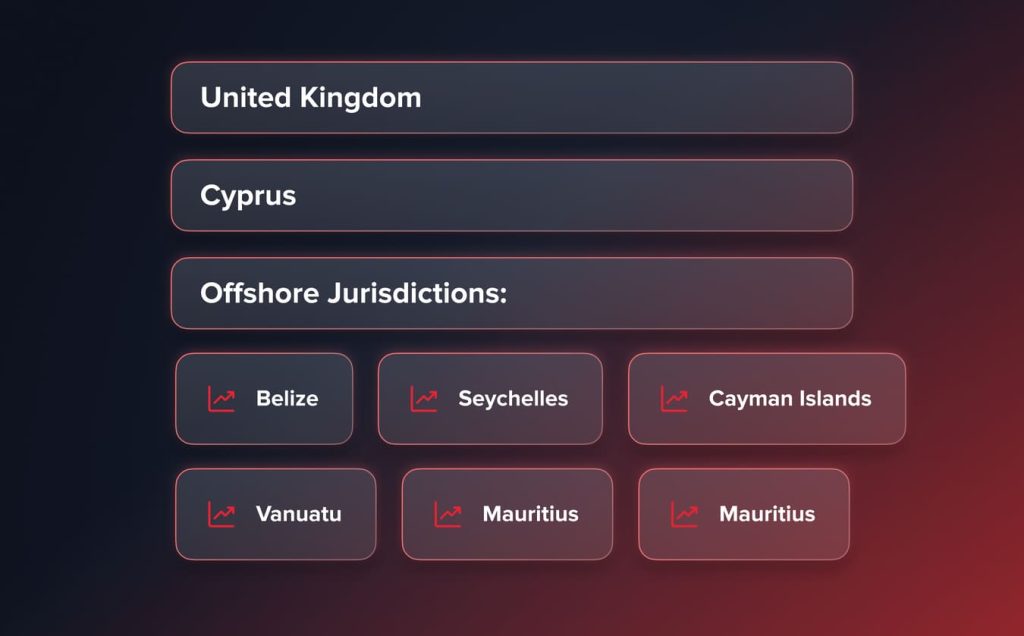
| Jurisdiction | Regulator | Approx. Capital | Setup Time | Reputation |
| United Kingdom | FCA | $125k – $1M+ | 12+ Months | Elite |
| Cyprus | CySEC | $50k – $730k | 6-12 Months | High (EU Access) |
| Mauritius | FSC | $25k | 4-6 Months | Moderate |
| Seychelles | FSA | $50k | 3-5 Months | Basic (Offshore) |
| Vanuatu | VFSC | $50k | 2-3 Months | Entry-Level |
Different countries offer different “flavors” of regulation. Here is a breakdown of where most brokers choose to set up.
United Kingdom (FCA)
The Financial Conduct Authority (FCA) is the “gold standard.”
- The Pros: Unmatched reputation. If you are FCA-regulated, the biggest banks and partners in the world will want to work with you.
- The Cons: It is incredibly expensive and the paperwork is a nightmare. Since Brexit, an FCA license no longer allows you to easily serve clients in the European Union.
Cyprus (CySEC)
Cyprus is the “Forex Hub of the World.”
- The Pros: Because Cyprus is in the EU, a CySEC license allows you to “passport” your services to all 27 EU member states. It’s a massive market access play.
- The Cons: Because so many brokers are there, the regulator has become much stricter over the last few years to maintain its standing with the rest of Europe.
Offshore Jurisdictions
For many startups, “Offshore” is the most realistic path. These jurisdictions offer a balance of lower costs and faster setup times.
Mauritius (FSC): A solid middle ground. It has a robust legal system based on English law and is a great gateway for brokers looking to target the African or Asian markets.
Belize (IFSC): Known for being very approachable. The application process is relatively fast, and the capital requirements are manageable for a new business.
Seychelles (FSA): A huge favorite for international brokers. It offers a very tax-friendly environment and doesn’t require a massive local physical presence.
Cayman Islands (CIMA): This is the “high-end” offshore option. It’s more expensive than Seychelles, but it carries a much higher level of respect among institutional investors.
Vanuatu (VFSC): Often the fastest place to get a license. It’s a popular choice for brokers who want to get to market quickly while still maintaining a legal, regulated status.
You may also like


Iva Kalatozishvili
August 14, 2024
Estimated Costs and Financial Planning
The cost of obtaining a brokerage license varies significantly depending on the jurisdiction and the complexity of the license (e.g., Market Maker vs. STP/Agency Model). Beyond the minimum capital requirements, firms must budget for:
- Application Fees: These are non-refundable government fees. For example, as of February 1, 2026, UK Companies House digital incorporation fees have increased to £100, while regulatory application fees for the FCA or CySEC can range from $3,000 to $10,000+.
- Infrastructure & Technology: Modern regulators now require proof of “Operational Resilience.” This includes secure hosting, trading platforms (like MT5 or proprietary software), and robust CRM systems.
- Compliance Personnel: Most jurisdictions require at least one local, resident Compliance Officer or Money Laundering Reporting Officer (MLRO).
- Professional Fees: Legal consultants and auditors are essential for drafting the 3-year financial projections and internal manuals required for the application.
Pro-Tip: Budget for at least 6 – 12 months of operational runway in addition to your initial capital. Regulators often reject firms that appear “under-capitalized” to handle market volatility.
Common Pitfalls: Why Applications Get Delayed
Even with a solid business plan, many applications stall during the Regulatory Review phase. Avoiding these common mistakes can save your firm months of delays:
- Inconsistent Documentation: Information in the business plan must perfectly match the details provided in the personal questionnaires for directors.
- Opaque Source of Wealth: Regulators in 2026 are extremely strict about the “Source of Funds” for the initial capital. Lack of clear, bank-verified audit trails for the founders’ investment is a leading cause of rejection.
- Weak “Mind and Management”: Using “nominee” directors who have no real decision-making power is increasingly scrutinized. Regulators want to see that the actual management of the firm is happening within the jurisdiction.
- Generic AML Policies: Standard “copy-paste” Anti-Money Laundering (AML) manuals often fail. Your policies must be tailored to your specific target market and asset classes.
Emerging Trends in 2026 Licensing
The brokerage landscape is shifting toward Digital Finance and Sustainability. When applying today, consider how these trends might affect your license type:
The “Crypto-Hybrid” Model
Many traditional brokerage licenses now require additional “VASP” (Virtual Asset Service Provider) registrations if you intend to offer crypto-assets. Under the EU’s MiCA (Markets in Crypto-Assets) regulation, which is fully operational in 2026, firms must meet specific knowledge and competence criteria to advise on digital assets.
AI and Algorithmic Trading
If your brokerage uses AI for trade execution or client profiling, regulators like the FCA now conduct “AI Live Testing” to ensure your algorithms don’t create market instability or bias against consumers.
ESG Reporting
Environmental, Social, and Governance (ESG) disclosures are moving from optional to mandatory. Be prepared to explain how your firm manages climate-related financial risks, especially if applying in top-tier jurisdictions like Mauritius or the UK.
Post-Licensing: The Ongoing Compliance Checklist
Obtaining the license is just the beginning. To keep it, you must adhere to a strict reporting calendar:
- Annual Audits: Submission of audited financial returns.
- Transaction Reporting: Real-time or daily reporting of all executed trades to the regulator.
- Fit and Proper Reviews: Annual reassessment of your board members’ competence.
- Capital Adequacy Reports: Monthly or quarterly filings to prove you still hold the required liquidity.
Conclusion
Getting a brokerage license is a significant investment of time and money, but it’s the only way to build a real, scalable company in the financial sector. Don’t rush the process. Start by picking a jurisdiction that fits your current budget, but always have a “Level Up” plan. Many of the world’s biggest brokers started with an offshore license in a place like Mauritius and eventually grew into an FCA or CySEC license once they had the revenue to support it.

