
A financial quarter (or fiscal quarter) divides the year into four equal periods, each lasting three months. The purpose of this is to facilitate regular performance analysis and reporting by various organizations. Hence, companies and governments use these periods to evaluate progress more frequently than annually, issue earnings reports, and manage budgets
In this article, we will discuss what a financial quarter is, how it works, some of the major differences between calendar quarters and fiscal quarters, and its importance in the world of finance.
What Is a Financial (Fiscal) Quarter?
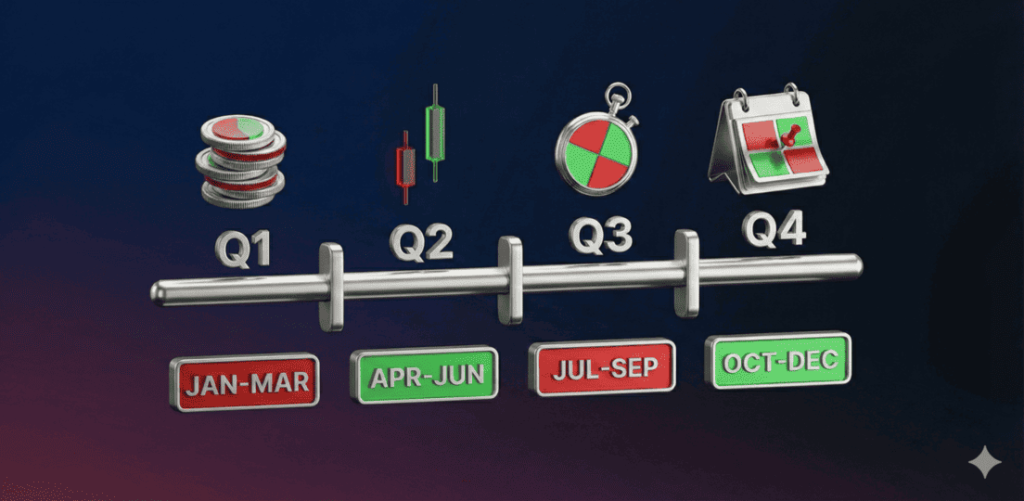
A financial or fiscal quarter can be defined as a three-month period that companies, organizations, the government, and investors use to record financial statements and perform financial analysis. Therefore, the 12 months in a year are divided into four quarters, each symbolizing a fourth of the whole period.
These quarters assist in the evaluation of performance in a more manageable time frame. Rather than taking a whole year, for instance, to evaluate revenue, expenses, profit, or losses, companies can make an assessment based on these quarters.
A fiscal quarter is associated with the financial year of a company or the government, which may not be the January to December year. While the financial year in many institutions is the January to December year, in others, the financial year may begin in different months depending on the business cycles.
How Financial Quarters Work
A financial quarter breaks down the financial year into four equal periods, enabling organizations to measure their financial performance. A financial quarter consists of three months:
- Q1 or 1st Quarter: This is the initial three months of a fiscal year. Organizations evaluate the start of a year, make plans, and keep track of trends.
- Q2 or Second Quarter: This phase includes the next three months. During this phase, companies appraise their performance in the first half of the year, and strategic changes might take place.
- Q3 or Third Quarter: Deals with the third three-month period. This is where organizations finalize preparations for the end-of-year targets, analyzing and forecasting for Q4.
- Q4 or Fourth Quarter: This is the last three-month period of the fiscal year. Annual closing of all organizations takes place, and plans for the next fiscal year are made.
With the division of the year into quarters, businesses can analyze trends associated with revenues, costs, and profits, thereby making appropriate decisions. Investors can also explore the financial position of a company through the quarterly reports presented by the firm.
How Financial Quarters are Structured
As mentioned in the previous section, in every financial year, there are four equal portions of three months each. These portions are identified as Q1, Q2, Q3, and Q4 in order.
For those who follow the calendar year, the following is the organizational structure.
- Q1 spans from January to March
- Q2 lasts from April to June
- Q3 lasts from July to September
- Q4 lasts from October to December
However, there are many businesses and even governments that operate with a fiscal year that begins in a different month. They could, for instance, commence their fiscal year in April, in July, or in October. In such a scenario, the Q1 would begin from that month, with intervals of three months after that.
This structure does not change, no matter the starting point. Each quarter reflects an equal time frame for reporting purposes, related to tracking earnings, spending, taxes, and objectives. There also comes a point where comparisons can be made from one quarter to another, as opposed to waiting until the end of the year.
Why Financial Quarters Matter for Businesses and Investors
- The quarters give you a simple, regular reminder to check on progress. Rather than waiting a whole 12 months to see if you’re getting the desired results, you get to check in every three months, make some changes in your approach when you still have time to.
- As for businesses, the use of quarters assists in budgeting, forecasting, and financial management. Revenues, expenses, and profitability are constantly analyzed, and it is therefore easy to identify bottlenecks or opportunities for growth before they become major challenges. Another aspect that is created as a result of using quarters is accountability.
- Investors look to quarters as critical inputs in decision-making. Companies list their quarterly earnings, which highlight revenue growth, profit margins, debt positions, and future projections. Around 72 % of investors say quarterly reports are more useful than earnings releases for this reason, and 91 % state that they contain incremental details such as management discussion and analysis.
- Regulators and tax authorities also depend on quarterly reporting. Many taxes, compliance, and economic estimates are measured in fiscal quarters, particularly for corporations.
Key Difference Between Calendar Quarters and Fiscal Quarters
While U.S. companies typically report quarterly due to SEC requirements, many global markets use semi-annual reporting instead. In global data covering around 11,000 publicly listed companies, only about 13 % reported twice a year, with the remainder following quarterly or more frequent schedules.
- However, calendar quarters are based on the regular calendar year, which runs from January to December. There are four equal intervals within a calendar year; Q1 represents the period from January to March, while Q2 is April to June, Q3 is July to September, and Q4 is from October to December. This is usually applicable when people, small companies, or organizations report on a calendar-year basis.
- Fiscal quarters, on the other hand, are based on a fiscal year chosen by the company. This doesn’t necessarily start in January, but any month, depending on when the company’s operations are best conducted. For instance, assuming the financial year of a given company opens in July, Q1 will be July to September, Q2 will be October to December, Q3 will be January to March, and Q4 will be April to June. The quarters still retain the same periods, but the schedule has changed.
The major difference between the two is flexibility. Calendar quarters are straightforward, whereas fiscal quarters enable the organization to synchronize its reporting with the demands or peak periods of sales. In many cases, for example, the ending of the fiscal year for retailers is after the holidays, thus Q4 will represent their peak sales period.
Why Companies Choose Different Fiscal Year Start Dates
The time when the new fiscal year begins is a company decision. It is often connected with the way the company operates the business, the source of income, or cost management. Highlighted below are reasons companies choose different fiscal year start dates:
Seasonality & Revenue Cycles
One primary consideration is seasonality. Many companies receive most of their revenue during specific times of the year. A good example is retail companies during the holiday seasons, when most of their sales are made. Starting the fiscal year after this peak season enables them to close their accounts when the season is over to get cleaner reports.
Operational Convenience
Another could be the ease of doing business. It has been noticed that several companies choose to end the year during the less busy periods in the business world. The result is that it becomes easier to process accounts and perform other tasks.
Tax & Regulatory Alignment
There are also concerns related to taxation and regulations. In certain jurisdictions, aligning the fiscal year with government reporting periods, industry norms, or tax considerations is helpful for ease of compliance and prediction.
Consolidated Reporting
Some companies choose to synchronize their fiscal year with that of their parent company or group. This is usually the case with larger companies that operate on a global platform, as it helps them reap the benefits of standardization.
How Companies Use Financial Quarters in Reporting and Decision-Making
Performance Tracking
The quarterly snapshot is more than simply figures—it’s the pulse check of the business. The way that companies line up the revenue, expenses, and profits against the target and the prior quarter to determine the rate of growth and whether it’s experiencing speeding up or adverse trends.
Investor and Stakeholder Communication
Public companies release results every quarter to demonstrate performance, whereas investors analyze profits, cash flows, and readiness for the future. In fact, even the private companies make use of this review mechanism to keep financiers, partners, and boards posted.
Budgeting and Financial Forecasting
Forecasting depends on what has happened in the recent quarters. Teams look at what happened and use that information to plan for the future. If there has been a tough quarter, they could adjust their spending or budgeting for the coming quarter, rather than waiting until the end of the year.
Risk Identification and Management
The quarterly checks highlight risks such as declining sales, increased expenses, or funding shortfalls. By identifying risks in time, management can quickly react to correct problems before they escalate. In sum, quarters help to segment large-scale goals into tangible action items. In other words, quarters bring organization to the financial execution of the year’s performance.
How Fiscal Quarters Affect Financial Reporting and Earnings
[image suggestion: stock market screen reacting to quarterly earnings announcements]
Publicly traded companies in the United States are required by regulators like the Securities and Exchange Commission (SEC) to file quarterly financial statements (Form 10-Q). The financial reports include revenue, expenditure, profits/losses, and future projections. It affects companies in the following ways:
Enhances Transparency
This is because, rather than waiting for the whole year to assess how they perform, stakeholders will be able to identify any problems early. If revenues fall, costs escalate, or profitability decreases, there would be early signs that need urgent attention.
Influences Internal decision-making
The management uses the fiscal quarters to analyze the budgets and make necessary allocations. A failure by the business to perform well in a particular fiscal quarter can help it adjust the pricing or the operations.
Pressures organizations
Organizations may fixate on short-term performance to satisfy market expectations, to the detriment of long-term plans. That is why organizations often have quarterly, annual, and long-term plans.
Companies With Different Fiscal Years
Not all businesses observe the January to December financial year. Large companies adopt fiscal years that suit their business cycle and periods of maximum sales. This helps them report financial performances in a more accurate manner.
Walmart
Walmart ends its fiscal year on January 31, which enables the company to record the entire holiday season, which is a key revenue-generating period for any retailer. Providing a clear indication of its performance, the company ends its financial year on a date close to the holiday season.
Apple
Instead of ending in December, the fiscal year of Apple closes on the last Saturday of September. This is because it matches Apple’s lineup of product launches, especially the launch of new iPhones and other gadgets in September. As a result of this financial year schedule, Apple’s reporting of financials now accurately depicts the revenue that originates from products.
NVIDIA
Its fiscal year ends on the last Sunday of January. This has proven helpful for the company, as it allows them to adjust for the high sales registered during the holidays, which is important for gaming, data center, and artificial intelligence-related products. This timing also allows the company to report its annual financial statements based on its peak sales quarter.
Eli Lilly
Eli Lilly’s fiscal year runs based on the standard calendar year, closing on December 31. The company has a good cycle that is aligned with its research and development processes. The completion of various results for clinical trials, regulatory approvals, and research milestones is done at the end of the year. The company’s fiscal year closing in December takes into account the various research and development milestones accomplished in the year.
Advanced Micro Devices (AMD)
The fiscal year of Advanced Micro Devices is concluded on the last Saturday of December every year. This is quite appropriate for this semiconductor company, as significant sales of their products usually take place in the second half of their financial year. The company thus gets to report on sales from new processors, graphics cards, and holiday demand in the second half of every financial year.
These variations illustrate why it’s essential to know a company’s fiscal year when analyzing financial statements or comparing performance across businesses and industries.
Common Misunderstandings About Financial Quarters
Many people misunderstand the reporting or performance of companies based on financial quarters. Here are the most prevalent misunderstandings:
Fiscal Year vs Calendar Year: Every company does not follow the calendar year system. The fiscal year begins in any month, so that Q1 for one company does not necessarily mean Q1 on the calendar year chart.
Quarter Dates Vary: Fiscal years are not fixed and may therefore affect the dates that mark the beginning and end of each quarter.
Reporting Time Lines: Often, companies put out financial reports after the end of a quarter, rather than immediately. A report for the end of Q2, for instance, would typically come out several weeks into the next quarter, which would be Q3.
Comparison Across Companies: Comparison of quarters across companies can be misleading if the fiscal year of the company is not taken into account. The holiday season, which impacts a company’s revenues in the fourth quarter, can occur in the first quarter of other companies.
Mixing Terms: Such terms as “quarterly earnings,” “quarterly revenue,” or “Q1/Q2” are at times interchanged without referencing the alignment with the fiscal year.
Conclusion
Financial quarters are not merely reporting cycles, but a systematic framework for analyzing the activities of businesses. These periods, however, allow businesses to make timely decisions, stay focused on their goals, and reap the benefits of the market. Understanding how financial quarters work, including the difference between calendar and fiscal quarters, also helps readers interpret earnings reports, market movements, and corporate announcements more accurately.

