Pip is a term that shows the last decimal place of a price quote. In the vast majority of trading pairs, the number of decimal places is 4; which is why one pip refers to 0.0001.
When talking about trading, a pip is a standard unit for measuring how much the exchange rate within a trading pair has changed.
Key takeaways:
- What is a pip in Forex trading?
- What does a pipette mean and how it differs from a pip?
- How to calculate a pip value?
- How to find a pip value in the chosen currency of your trading account?
- What does a spread mean and how it depends on pips?
What is a Pip in Forex Trading?
A pip is a shortening that can be decoded as ‘Percentage In Points.’ It is a standard unit of a trading pair’s price change. Traditionally, a pip corresponds to the 4th digit after the decimal point. Meanwhile, the exception exists as well.
Let’s dive deeper into the understanding of a pip to illustrate how it works in examples.
The exchange rates of the vast majority of trading pairs are given with four decimal places. For instance:
- The exchange rate of USD/BRL is 5.7264;
- The exchange rate of EUR/CAD is 1.5140;
- The exchange rate of AUD/CHF is 0.5649;
The 4th digit after the decimal point is named a pip to simplify the calculations.
For instance, how to mark the difference, when the exchange rate of USD/BRL has changed from 5.7264 to 5.7269? If we say that the price changed by 0.0005, it will be complicated and unclear. Especially for Forex trading, when seconds are of much account.
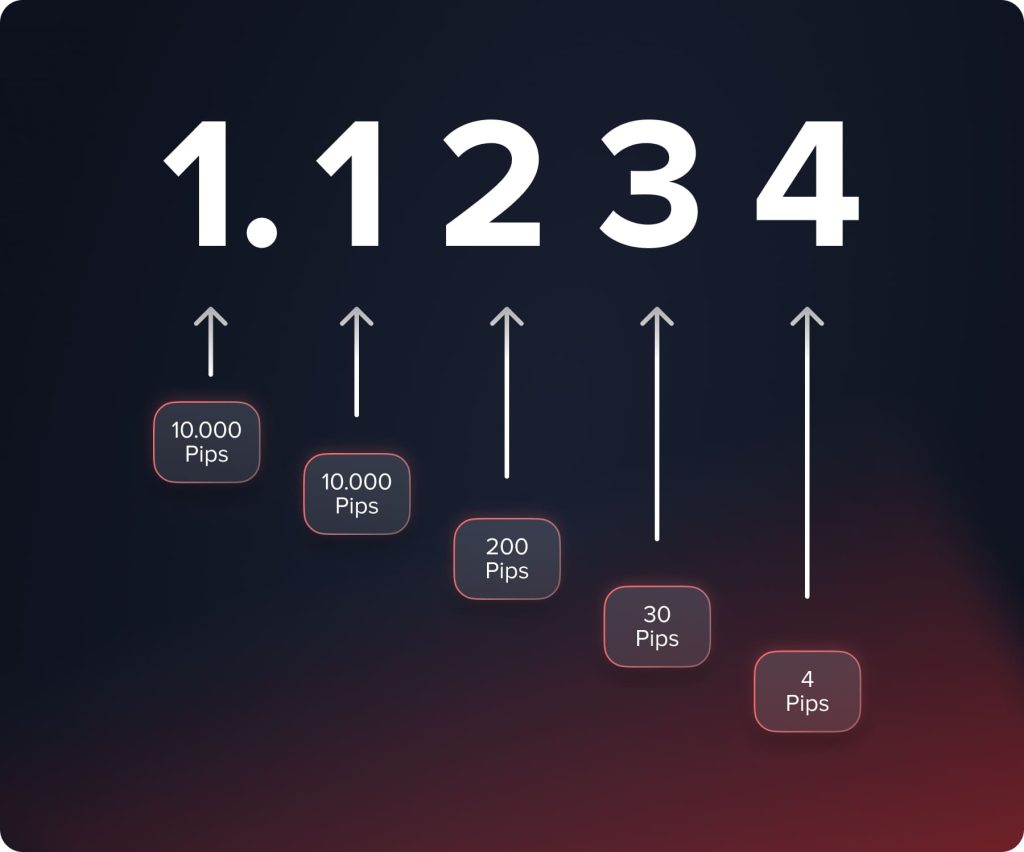
The introduction of a pip made the calculations much simpler. At present, we may say that the USD/BRL price has changed by 5 pips, and every investor or trader understands what we mean.
Meanwhile the rule doesn’t work for trading pairs with the Japanese Yen (JPY). When it comes to JPY pairs, one pip is the 2nd digit after the decimal point. For instance, when a trader needs to inform us about the EUR/JPY price change from 164.36 to 164.39, he says that the price increased by 3 pips.
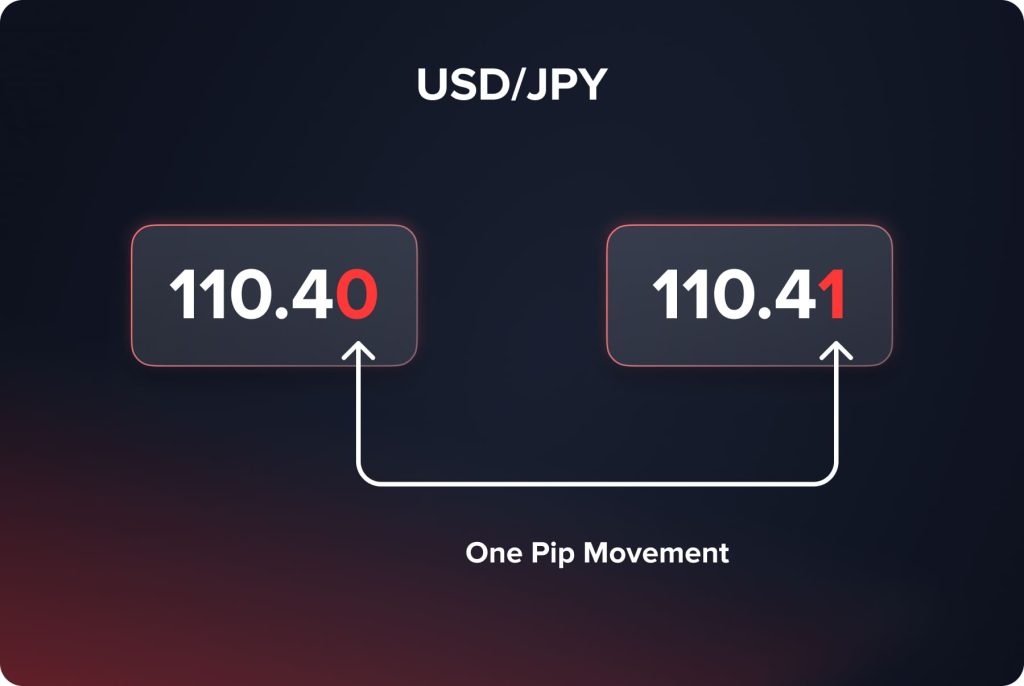
Apart from the trading pairs that include JPY the same situation occurs in the market of metals. When talking about gold, silver, and other metals, a pip is the 2nd digit as well.
Translate a price move into pips and pipettes
Choose the quote style, then enter two prices. The block shows the move in pips, pipettes, and raw price difference.
What is a Pipette in Forex Trading? The Difference Between Pips and Pipettes
At first, a pip was understood as the smallest measurement unit for calculating the changes of an asset’s price. Meanwhile, over time, more accurate measurement appeared. Many up-to-date Forex brokers display asset prices with 5 digits after the decimal point (in case of currencies paired with JPY, 3 digits are available).
As such, the exchange rate of USD/BRL is not 5.7264 but 5.72648. The exchange rate of EUR/JPY is not 164.36 but 164.361.
It is obvious that there was a need to introduce an additional measurement unit to mark the 5th digit after the decimal point.
A pipette is understood as a fractional pip (1/10 of a pip). When we need to inform traders that the EUR/USD price has changed from 1.19565 to 1.19579, we may say that the price increased by 1 pip and 4 pipettes or by 14 pipettes.
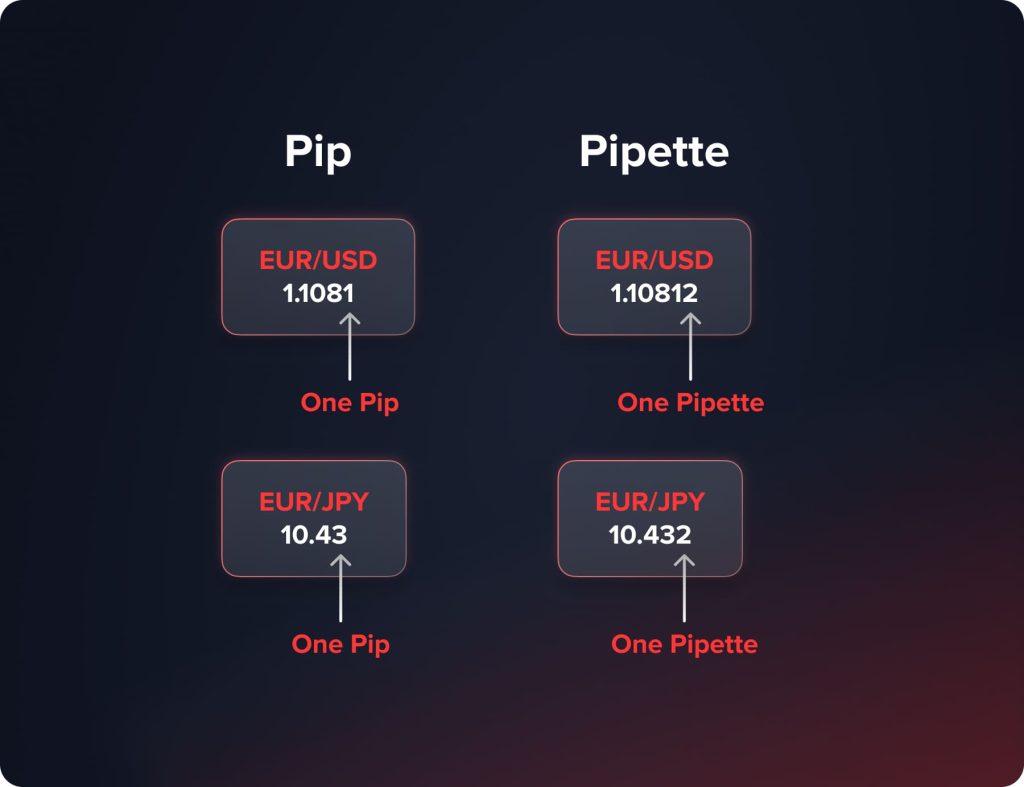
Here is why a pipette lets Forex traders and investors to identify exchange rates as precisely as possible.
What is a Pip Value and How to Calculate It?
Why do traders need to calculate a pip value? Trading accounts are open in real currencies, not pips; which is why you need to understand a pip value to evaluate the profit or loss of your trade properly. Such an understanding helps traders choose the right risk management strategy.
A pip value is influenced by the following factors: a trading pair, a trade size; and the current exchange rate.
Furthermore, the way of calculating a pip value directly depends on a currency position in a trading pair. Based on that position, there are two ways of calculating a pip value.
For instance, to calculate a pip value in the quote currency we need to apply the following formula:
Pip Value = Trade Size (in units) * 0.0001
Let’s calculate the value of a standard lot (100,000 units) of EUR/USD. We need to multiply 100,000 by 0.0001 and get 10. What does it mean? Every pip of that trade is equal to $10. When a trader’s position grows at 3 pips, he gets the profit of $30, and vice versa.
At the same time, there are situations when a trader account’s currency doesn’t correspond to the quote currency. What should they do? Let’s calculate a pip value within the EUR/JPY trading pair. First and foremost, we need to use the same formula. Pip Value = 100,000 units * 0.01 (for JPY we use the multiplier 0.01 instead of 0.0001). The pip value of the EUR/JPY trading pair is 1000; which means 1 pip is equal to 1000 JPY. Meanwhile, our trading account utilizes US dollars. What is the EUR/JPY pip value in USD? We need the following formula for such a case:
Pip Value (in a trading account’s currency) = Pip Value (of the quote currency) / Exchange Rate
Let’s put the required values into the formula. Pip Value (in USD) = 1,000 JPY / 154.133 (the USD/JPY exchange rate) = 6.48 USD.
Since we have calculated a pip value in USD, it becomes much simpler to follow the chosen risk-management strategy, utilize stop-loss and take-profit instruments, and calculate profits/losses of every deal.
How much is one pip worth for this position?
Pip value changes with lot size, pip size, and quote-currency conversion. Use this before turning a stop-loss distance into account risk.
Use Cases of Pip and Pipette
Why do traders need to understand the difference between pips and pipettes, and how to use those measurement units in practice? Here are the most common use cases:
- Expressing a price change of a certain asset. It is rather hard to use traditional numbers when talking about the 4th and 5th decimal digits. You may simplify the explanation through introducing pips and pipettes. Examples:
The price of EUR/USD has dropped by 9 pips.
The price of USD/JPY has increased by 27 pipettes.
- Expressing profits and losses. The same situation occurs – it is much easier to explain your gains or losses through pips and pipettes. Examples:
I made 75 pips from the last trade.
This trade made me lose 84 pipettes.
- Setting stop-loss and take-profit orders. When entering a trade, professional traders always utilize stop-loss and take-profit instruments. Pips and pipettes help understand what are the price levels to set such orders. Examples:
In the last trade I used a stop-loss of 40 pips and a take-profit of 52 pips.
A stop-loss of 110 pipettes helped me avoid heavy losses.
- Expressing the spread. The difference between ask and bid prices is always expressed in pips.
When talking about spreads, we need to dwell on it in detail. What does it mean in the Forex market, and why do you need to use pips to express it?
What is a Spread in Forex?
No matter which financial markets are taken into account, a spread means the difference between bid and ask prices. What does it mean?
- Bid price is the price at which traders can sell their assets.
- Ask price is the price at which traders can buy assets.
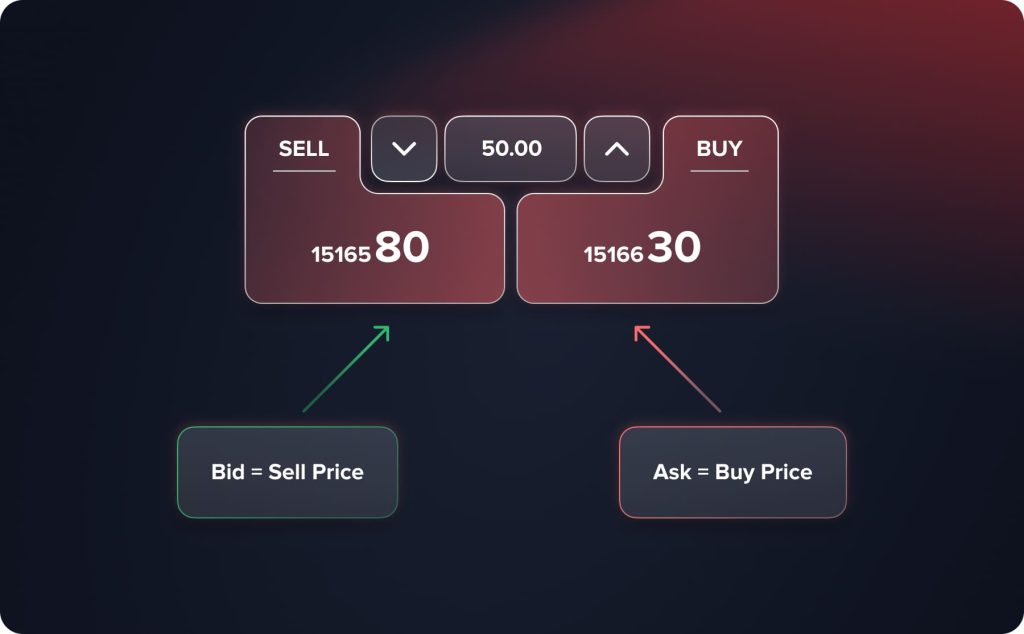
For instance, the bid price for EUR/USD is 1.12704, and the ask price for the same trading pair is 1.12718. The difference between ask and bid prices is 0.00014 (14 pipettes).
In the Forex market spreads are always expressed in pips; which is why this difference is marked as 1 pip.
Spreads are divided into fixed and floating ones. The fixed spread never changes, regardless of market conditions. For instance, a brokerage company offers the fixed spread of 8 pips for metals. It means that the difference between ask and bid prices for metals will always be 8 pips (0.08).
Spreads fall into the category of options brokers get profits through. The vast majority of brokerage companies do not charge fees and commissions, but spreads usually start from 2 pips. When a trader opens a position, he loses 2 pips from the very beginning.
Furthermore, brokers may offer different account types, with or without fees. When a broker charges commissions, spreads start from 0 and entirely depend on the market conditions. When fees are 0%, spreads let brokerage companies make profits from every deal. Before opening an account, you need to take into account the expected number of trades and their volumes to understand which account type is the best for you.
Convert bid/ask spread into pips, points, and cost
Use the same quote style as your platform. The result shows why many trades start negative: price must first move enough to cover the spread.
You may also like

Demetris Makrides
August 19, 2024
What is a Trader’s Profit in Pips?
Professional Forex traders fix their profits in pips. What are their profits from one trade, one day, one week, etc.?
Profits depend much on the chosen trading style and strategies. Scalpers try to get from 5 to 10 pips from a trade. Intraday traders expect to get from 10 to 30 pips from a trade. As for long-term traders and investors, they open a position to get profits of 50-100 pips, and even more. As such, daily, weekly, and monthly incomes depend on the number of profitable trades.
Pips Across Other Asset Classes: Indices and Commodities
While “pip” is a Forex-centric term, modern multi-asset brokers often use “points” or “ticks” for other instruments. Understanding these is vital if you trade more than just currencies.
- Stock Indices (e.g., US500, NAS100): Here, we usually talk about Points. A move from 5,000.00 to 5,001.00 is a 1-point move. In many platforms, 1 point is equivalent to 100 “pips” in terms of how the software calculates profit/loss.
- Gold (XAU/USD): Gold is quoted to two decimal places. A move from $2,050.50 to $2,050.51 is often referred to as a tick or a pipette, while a move to $2,050.60 is 1 pip.
- Oil (WTI/Brent): Oil is also typically quoted to two decimals. A $0.01 change is the smallest increment, often referred to as a “cent” or a pip depending on the broker’s terminology.
Lot Sizes and Pip Value: A Quick Reference
The “value” of a pip is not fixed; it scales directly with your position size. In 2026, most retail traders use one of three standard lot sizes. Assuming your account is in USD and USD is the quote currency (like EUR/USD):
| Lot Type | Units of Currency | Pip Value (Approx.) |
| Standard Lot (1.0) | 100,000 | $10.00 |
| Mini Lot (0.1) | 10,000 | $1.00 |
| Micro Lot (0.01) | 1,000 | $0.10 |
Crucial Tip: If you are trading a Micro Lot, a 100-pip move only equals $10. If you are trading a Standard Lot, that same move is worth $1,000. This is why position sizing is the most important part of risk management.
Pips vs. Points in MetaTrader 5 (MT5)
If you use the industry-standard MT5 platform, you might notice the term “Points” in your terminal window. It is important not to confuse these with Pips.
- 1 Pip = 10 Points: On a 5-decimal platform, “Points” refers to the 5th decimal (the pipette).
- Example: if the spread is shown as “12,” it means 12 points, which is actually 1.2 pips.
Understanding this distinction prevents you from setting a Stop Loss that is 10 times tighter than you intended.
Why Pip Values Change (The Quote Currency Rule)
A common mistake for beginners is assuming every pip is worth $10 on a standard lot. This is only true if USD is the second currency in the pair (the Quote Currency).
- USD as Quote (EUR/USD, GBP/USD): Pip value is fixed (usually $10/standard lot).
- USD as Base (USD/JPY, USD/CAD): The pip value fluctuates based on the current exchange rate.
- Formula: (0.0001 / Exchange Rate) X Lot Size = Pip Value in Base Currency
- Cross Pairs (EUR/GBP, AUD/NZD): The pip value is calculated in the quote currency (e.g., GBP or NZD) and then converted back to your account currency (USD) at the current market rate.
Professional Tip: Using Pip Calculators
In 2026, you don’t need to do this math manually during a fast-moving market. Most professional brokers provide an integrated Pip Calculator inside their CRM or trading app.
Before entering a trade, simply input your:
- Instrument (e.g., USD/JPY)
- Account Currency (e.g., EUR)
- Trade Size (e.g., 0.5 lots)
The tool will instantly tell you exactly how much you stand to gain or lose per pip, allowing you to set your Risk-to-Reward ratio accurately.
Bottom Line
A pip is a measurement unit used in financial markets to express price changes, profit/losses, and spreads. It simplifies calculations as traders and investors do not need to get lost into decimal digits. Within most assets a pip is referred to the 4th digit after the decimal point. For JPY-paired assets and metals a pip means the 2nd decimal digit. Furthermore, a pip is not the smallest measurement unit. As soon as the quotes began to be expressed in five decimal digits, a fractional pip (pipette) appeared. When using pips and pipettes traders save much time for making the required calculations.

