
- Respaldada por materias primas: Una moneda basada en materias primas requería que la autoridad gobernante mantuviera reservas suficientes para garantizar el canje.
- Transportabilidad y usabilidad: son más fáciles de transportar y usar en comparación con el dinero en mercancía. En lugar de llevar monedas de oro, las personas podrían llevar pedazos de papel que indicaran la propiedad de un determinado número de unidades del activo subyacente.
- Se basa en gran medida en la confianza y reservas: Solo funcionaría de manera eficiente si el emisor mantiene una cierta reserva de mercancía y la redime cuando sea necesario.
- Es costoso y limitante para el gobierno mantener reservas de productos básicos.
- También es propenso a fallar si se pierde la confianza en el proceso de redención o si se agotan las reservas.
- El dinero fiduciario es emitido y regulado por los gobiernos, generalmente a través de bancos centrales como la Reserva Federal y el Banco Central Europeo. Estas instituciones controlan la oferta monetaria y supervisan la estabilidad financiera.
- Es moneda de curso legal, lo que implica que las empresas y los individuos deben aceptarla por bienes y servicios dentro del país emisor.
- La fortaleza del dinero fiduciario se basa en la confianza y la estabilidad económica. La credibilidad del gobierno en cuestiones de control de inflación, deuda y crecimiento económico es significativa para determinar el poder adquisitivo del dinero.
- Se puede producir, gestionar y distribuir fácilmente. Los gobiernos pueden imprimir más dinero fiduciario en respuesta a ciertas condiciones económicas, como recesiones, inflación o crisis financieras.
- El dinero fiat enfrenta amenazas de inflación y la devaluación de la moneda. Esto puede ocurrir si se imprime demasiado dinero y la gente pierde confianza en él.
- Dado que el dinero fiduciario no es dinero mercancía, carecerá de valor si las personas pierden confianza en él.
- Los bancos centrales y los gobiernos pueden manipular la oferta y las tasas de interés, lo que puede llevar a burbujas artificiales o crisis económicas.
- El dinero digital no es físico. Todos los registros sobre propiedad y valor se almacenan en las bases de datos de las instituciones bancarias.
- Es muy rápido y conveniente, facilitando transferencias de fondos instantáneas o casi instantáneas sobre una amplia área geográfica, potencialmente incluso a través de una gran área geográfica como un país.
- El dinero digital depende de la infraestructura financiera y tecnológica. Se necesita un banco, un procesador de pagos, una conexión a internet y sistemas seguros para almacenar y transferir valores.
- Se basa en la tecnología y la conectividad; por lo tanto, la pérdida de conectividad, el hacking o simplemente la falta de internet pueden obstaculizar los pagos.
- También se ha visto empañado por preocupaciones de seguridad y privacidad.
- Las criptomonedas son descentralizadas y utilizan el concepto de tecnología blockchain, mediante el cual los registros de transacciones se almacenan en un sistema descentralizado.
- Muchas de estas criptomonedas tienen suministros fijos. Por ejemplo, Bitcoin tiene un suministro fijo de 21 millones de unidades, lo que lo hace escaso, contribuyendo así a su valor.
- Se caracterizan por una alta volatilidad de precios. Sus precios pueden bajar o subir rápidamente. Como resultado, se consideran ideales para el comercio pero no son adecuados para negocios diarios.
- La adopción sigue siendo muy variable según el país, debido a preocupaciones sobre la regulación, la volatilidad de los precios y la adopción por parte de los proveedores.
- También siguen existiendo preocupaciones de seguridad, incluyendo el robo de billeteras y actividades fraudulentas.
- Las CBDC son emitidas y gestionadas por los bancos centrales. Por lo tanto, forman parte del sistema monetario de una nación.
- Se consideran moneda de curso legal, lo que significa que deben ser aceptadas como pago, al igual que el dinero.
- Están diseñados para promover la eficiencia en los pagos, así como fomentar la inclusión, especialmente entre los no bancarizados.
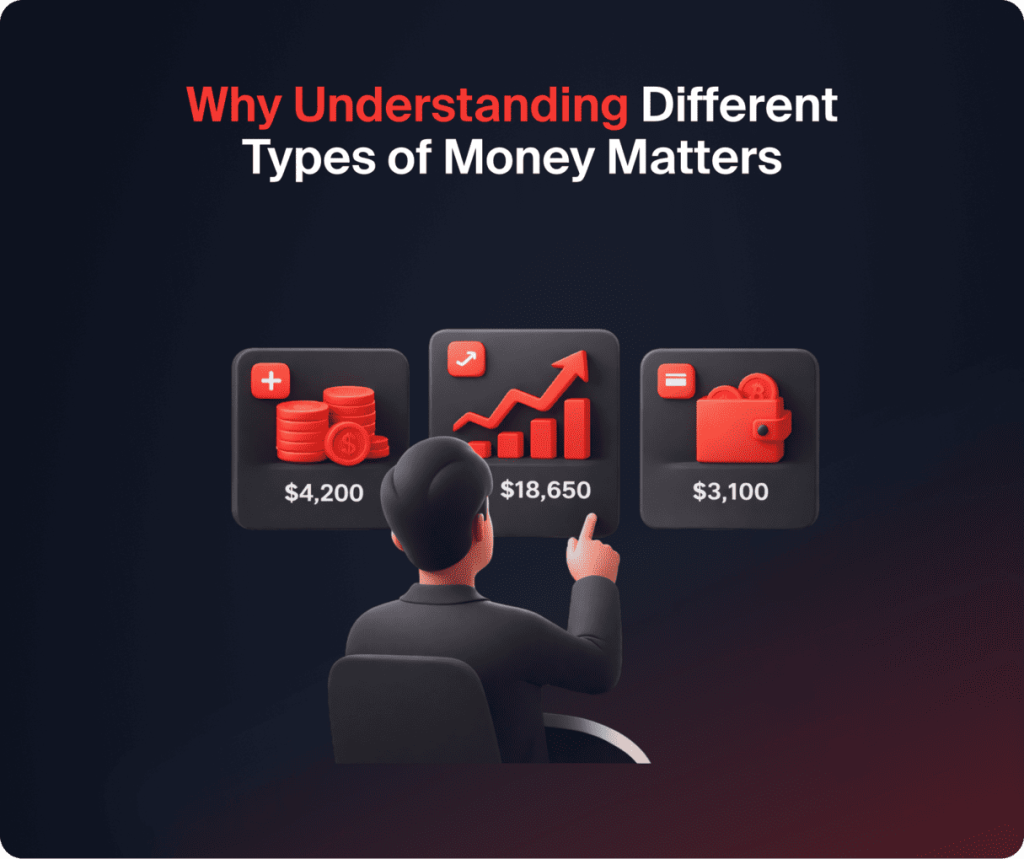
- Con conocimientos sobre monedas fiat estables, criptomonedas volátiles y monedas respaldadas por activos, las personas pueden tomar decisiones informadas al ahorrar e invertir dinero.
- A medida que las economías se trasladan a sistemas digitales y sin efectivo, se requiere familiaridad con el dinero digital, las criptomonedas y las CBDC. Tal conocimiento promueve la adopción fluida de nuevas tecnologías en el sector de los sistemas de pago.
- Cada tipo de dinero tiene diferentes niveles de riesgos, que incluyen riesgos de inflación, volatilidad de precios y regulaciones. Por lo tanto, su comprensión brinda a individuos e instituciones una forma de estimar mejor los riesgos y oportunidades financieros.
- Para las empresas, así como para los inversores, comprender cómo funcionan los diferentes tipos de dinero dentro de los distintos sistemas financieros conduce a una mejor capacidad de toma de decisiones en términos de planificación, precios, así como riesgo dentro de la economía.
- Debe ser identificable para que las personas puedan aceptarlo fácilmente.
- Debe ser duradero, lo que significa que puede utilizarse varias veces sin descomponerse en inutilidad.
- Debe ser divisible en unidades más pequeñas para atender a todos los valores de intercambio.
- Debe ser fácilmente transportable a otros lugares.
- Sobre todo, el dinero debe ser confiable, ya que su valor depende de la aceptación colectiva.
- Valor inherente: El valor del dinero mercancía no se basa en su uso como dinero. A diferencia del dinero en papel o digital, su valor no desaparece si deja de ser utilizado como moneda. El oro, por ejemplo, sigue siendo valioso debido a su uso en joyería, tecnología e industria.
- Oferta Limitada: Vinculada a recursos naturales y no puede ser producida libremente; por lo tanto, no contribuye a la inflación.
- No necesitar apoyo gubernamental: La aceptación se basó en un entendimiento común del beneficio y la rareza, en lugar de una creencia en una autoridad central.
- Problema de Transporte: Mover mercancías, como ganado, metales y otros bienes voluminosos, de un lugar a otro era bastante engorroso.
- Indivisibilidad: Puede resultar difícil dividir el ganado o ciertos productos en unidades pequeñas. Tales unidades pequeñas pueden reducir el valor de los productos.
- No es fácil de almacenar: El dinero mercancía puede descomponerse, deteriorarse y necesitar mantenimiento, lo que aumenta el costo de almacenamiento.
- Respaldada por materias primas: Una moneda basada en materias primas requería que la autoridad gobernante mantuviera reservas suficientes para garantizar el canje.
- Transportabilidad y usabilidad: son más fáciles de transportar y usar en comparación con el dinero en mercancía. En lugar de llevar monedas de oro, las personas podrían llevar pedazos de papel que indicaran la propiedad de un determinado número de unidades del activo subyacente.
- Se basa en gran medida en la confianza y reservas: Solo funcionaría de manera eficiente si el emisor mantiene una cierta reserva de mercancía y la redime cuando sea necesario.
- Es costoso y limitante para el gobierno mantener reservas de productos básicos.
- También es propenso a fallar si se pierde la confianza en el proceso de redención o si se agotan las reservas.
- El dinero fiduciario es emitido y regulado por los gobiernos, generalmente a través de bancos centrales como la Reserva Federal y el Banco Central Europeo. Estas instituciones controlan la oferta monetaria y supervisan la estabilidad financiera.
- Es moneda de curso legal, lo que implica que las empresas y los individuos deben aceptarla por bienes y servicios dentro del país emisor.
- La fortaleza del dinero fiduciario se basa en la confianza y la estabilidad económica. La credibilidad del gobierno en cuestiones de control de inflación, deuda y crecimiento económico es significativa para determinar el poder adquisitivo del dinero.
- Se puede producir, gestionar y distribuir fácilmente. Los gobiernos pueden imprimir más dinero fiduciario en respuesta a ciertas condiciones económicas, como recesiones, inflación o crisis financieras.
- El dinero fiat enfrenta amenazas de inflación y la devaluación de la moneda. Esto puede ocurrir si se imprime demasiado dinero y la gente pierde confianza en él.
- Dado que el dinero fiduciario no es dinero mercancía, carecerá de valor si las personas pierden confianza en él.
- Los bancos centrales y los gobiernos pueden manipular la oferta y las tasas de interés, lo que puede llevar a burbujas artificiales o crisis económicas.
- El dinero digital no es físico. Todos los registros sobre propiedad y valor se almacenan en las bases de datos de las instituciones bancarias.
- Es muy rápido y conveniente, facilitando transferencias de fondos instantáneas o casi instantáneas sobre una amplia área geográfica, potencialmente incluso a través de una gran área geográfica como un país.
- El dinero digital depende de la infraestructura financiera y tecnológica. Se necesita un banco, un procesador de pagos, una conexión a internet y sistemas seguros para almacenar y transferir valores.
- Se basa en la tecnología y la conectividad; por lo tanto, la pérdida de conectividad, el hacking o simplemente la falta de internet pueden obstaculizar los pagos.
- También se ha visto empañado por preocupaciones de seguridad y privacidad.
- Las criptomonedas son descentralizadas y utilizan el concepto de tecnología blockchain, mediante el cual los registros de transacciones se almacenan en un sistema descentralizado.
- Muchas de estas criptomonedas tienen suministros fijos. Por ejemplo, Bitcoin tiene un suministro fijo de 21 millones de unidades, lo que lo hace escaso, contribuyendo así a su valor.
- Se caracterizan por una alta volatilidad de precios. Sus precios pueden bajar o subir rápidamente. Como resultado, se consideran ideales para el comercio pero no son adecuados para negocios diarios.
- La adopción sigue siendo muy variable según el país, debido a preocupaciones sobre la regulación, la volatilidad de los precios y la adopción por parte de los proveedores.
- También siguen existiendo preocupaciones de seguridad, incluyendo el robo de billeteras y actividades fraudulentas.
- Las CBDC son emitidas y gestionadas por los bancos centrales. Por lo tanto, forman parte del sistema monetario de una nación.
- Se consideran moneda de curso legal, lo que significa que deben ser aceptadas como pago, al igual que el dinero.
- Están diseñados para promover la eficiencia en los pagos, así como fomentar la inclusión, especialmente entre los no bancarizados.
- Con conocimientos sobre monedas fiat estables, criptomonedas volátiles y monedas respaldadas por activos, las personas pueden tomar decisiones informadas al ahorrar e invertir dinero.
- A medida que las economías se trasladan a sistemas digitales y sin efectivo, se requiere familiaridad con el dinero digital, las criptomonedas y las CBDC. Tal conocimiento promueve la adopción fluida de nuevas tecnologías en el sector de los sistemas de pago.
- Cada tipo de dinero tiene diferentes niveles de riesgos, que incluyen riesgos de inflación, volatilidad de precios y regulaciones. Por lo tanto, su comprensión brinda a individuos e instituciones una forma de estimar mejor los riesgos y oportunidades financieros.
- Para las empresas, así como para los inversores, comprender cómo funcionan los diferentes tipos de dinero dentro de los distintos sistemas financieros conduce a una mejor capacidad de toma de decisiones en términos de planificación, precios, así como riesgo dentro de la economía.
Limitaciones del Dinero Representativo
A medida que las economías globales crecieron, la mayoría de las naciones abandonaron el dinero representativo a favor del sistema fiduciario, lo que permitió un mayor control monetario. Aunque ya no se utiliza de manera generalizada, el dinero representativo tuvo un papel fundamental en la creación de la banca moderna, las reservas y la política monetaria.
Dinero Fiat
El dinero fiduciario representa la forma de dinero más utilizada en la sociedad contemporánea. Se diferencia del dinero mercancía en que carece de valor intrínseco y no está respaldado por mercancías, incluyendo oro y/o plata. Su valor radica en la fortaleza de la autoridad emisora (gobierno), la confianza del público en la institución emisora y la economía en general.
Hoy en día, casi todos los países operan con un sistema de dinero fiduciario. Ejemplos comunes incluyen el dólar estadounidense (USD), el dólar canadiense (CAD), el euro (EUR) y la libra esterlina (GBP), etc.
Características Clave del Dinero Fiat
Limitaciones de la Moneda Fiat
A pesar de tales riesgos, la moneda fiduciaria ha permanecido como la columna vertebral de las economías alrededor del mundo debido a su eficiencia y adaptabilidad.
Dinero Electrónico
El dinero digital es completamente digital, sin representación física como monedas y efectivo. El dinero digital se almacena y se lleva utilizando plataformas digitales como bancos y mecanismos de pago en línea, incluidos aquellos en teléfonos inteligentes.
Hoy en día, la mayoría del dinero utilizado es digital. Los salarios pueden pagarse digitalmente, y las transacciones pueden realizarse de manera digital. Las compras pueden hacerse digitalmente o a través de tarjetas y dinero en efectivo digital. En agosto de 2025, el sistema UPI de India aumentó un 34% registrando 20 mil millones de transacciones en un solo mes, lo que destaca cómo el dinero digital está superando el uso del efectivo tradicional.
Ejemplos típicos de dinero digital incluyen el dinero encontrado en una cuenta bancaria, dinero en una tarjeta de débito o crédito, dinero móvil, así como dinero en servicios de pago en línea como PayPal, entre otros.
Características Clave del Dinero Digital
Limitaciones del Dinero Digital
A pesar de estos desafíos, las monedas digitales están en el corazón de las economías hoy en día, impulsando los pagos, las transacciones transfronterizas y un sistema financiero digital.
Criptomoneda
La criptomoneda es una moneda digital que funciona sin el control de los bancos centrales y los gobiernos. Utiliza una tecnología conocida como blockchain, una forma de libro mayor distribuido que almacena detalles de transacciones en una red de computadoras. Tal tecnología permite un sistema de consenso para el procesamiento de transacciones sin requerir un sistema de control central.
A partir de principios de 2025, aproximadamente 659 millones de personas, alrededor del 8.3% de la población global, poseen alguna forma de moneda digital. Además, la capitalización de mercado global de criptomonedas actual es de aproximadamente $3 billones a partir del 21 de diciembre de 2025. Este valor ha experimentado un crecimiento significativo en 2025, incluso brevemente superando los $4 billones en el tercer trimestre de 2025, reflejando un crecimiento significativo en la adopción.
Las criptomonedas más prominentes son Bitcoin, que fue diseñado como un reemplazo entre pares para la moneda tradicional, y Ethereum, que va más allá de los límites de meras transacciones para habilitar contratos inteligentes y otras aplicaciones.
Características Clave de las Criptomonedas
Limitaciones de las Criptomonedas
Sin embargo, el impacto de las criptomonedas no se ha visto afectado por estos desafíos, y continúa afectando el sistema financiero global.
Moneda Digital de Banco Central (CBDC)
Una Moneda Digital de Banco Central, a menudo referida como CBDC, es la forma digital de una moneda fiduciaria, y esta moneda fiduciaria es emitida por el banco central. Una CBDC es diferente de la criptomoneda ya que está respaldada por el gobierno, y tiene el mismo estatus que el dinero en papel. Sin embargo, las CBDC están ganando tracción global con más de 130 países explorando o pilotando CBDCs. Las proyecciones muestran que los volúmenes de transacciones podrían expandirse de 307 millones en 2024 a 7.8 mil millones para 2031.
Este aumento en los volúmenes de transacciones puede verse influenciado por su diseño para proporcionar un sistema de pago modernizado a los países. Este diseño se logra al combinar la velocidad y conveniencia del dinero digital con la estabilidad del dinero emitido por el banco central. Generalmente se emiten de manera electrónica y se utilizan para realizar pagos, transferir fondos y ahorrar dinero.
Estos incluyen, por ejemplo, el eNaira de Nigeria, una de las primeras CBDC minoristas completamente lanzadas, y proyectos piloto emprendidos por bancos centrales en regiones como Europa, Asia y las Américas.
Características Clave de las CBDCs
Rol y Futuro de las CBDCs
Los bancos centrales ven las CBDC como instrumentos para minimizar los costos de transacción y promover la transparencia. Las CBDC podrían convertirse en instrumentos para que los gobiernos aborden el lavado de dinero y aumenten la eficiencia de la asignación de fondos públicos.
No obstante, las CBDC también plantean ciertas preguntas con respecto a la privacidad, la seguridad de los datos y la participación de los bancos comerciales, y por lo tanto, un gran número de países aún se encuentran en la etapa de investigación y piloto.
Cómo difieren los principales tipos de dinero
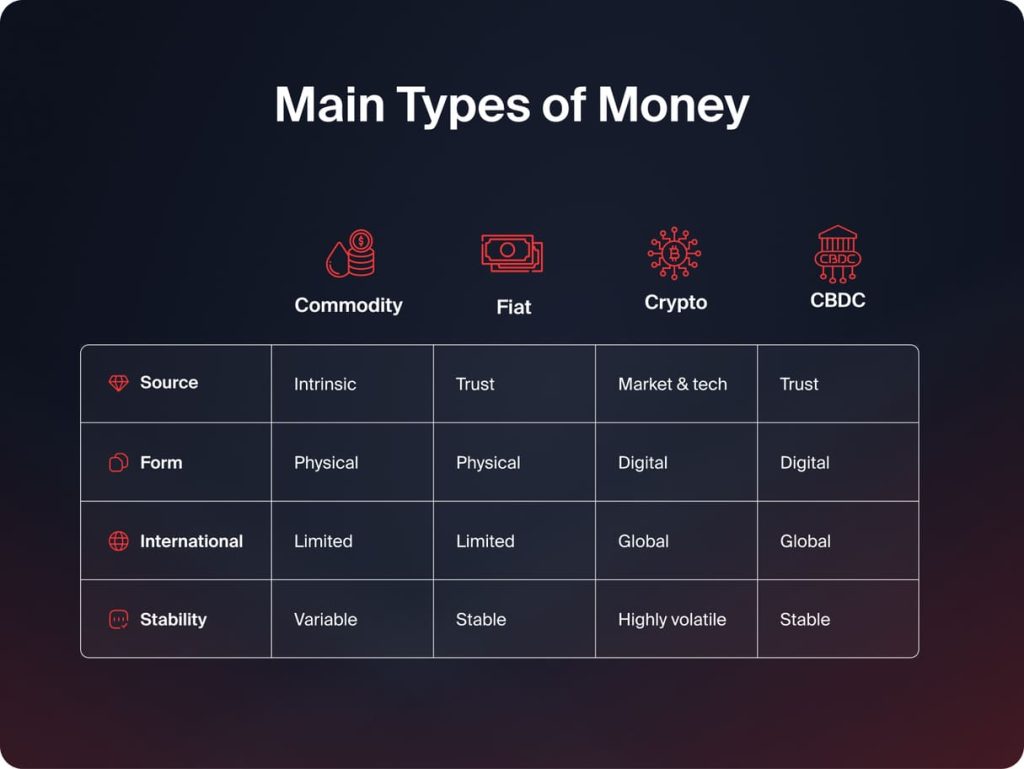
Los tipos básicos de dinero se distinguen según el origen y el control del dinero, su forma y su estabilidad. Conocer estas distinciones es importante para comprender cómo más de un tipo de dinero puede coexistir dentro de la economía.
Fuente de Valor
Existen tipos de dinero cuyo valor proviene del valor intrínseco. El dinero mercancía, como el oro o la plata, obtiene su valor debido a sus propiedades. Sin embargo, otros tipos de dinero, como el dinero fiduciario y el CBDC, no provienen necesariamente de algo que tenga valor intrínseco. Una nueva clase incluye el dinero como Bitcoin, cuyo valor proviene de las fuerzas del mercado, los avances tecnológicos y la usabilidad.
Control y Emisión
El control sobre estas formas de dinero varía significativamente. Mientras que el dinero fiat y las CBDCs son impresos y controlados por el gobierno y los bancos centrales, las criptomonedas son descentralizadas, lo que significa que funcionan sin un control central. Sin embargo, utilizan un sistema distribuido para validar las transacciones.
Formulario y Accesibilidad
El dinero puede ser físico o digital. El dinero tradicional en forma de mercancía y el dinero fiduciario se pueden ver en forma física, ya sea en forma de monedas o billetes, mientras que el dinero digital, las criptomonedas y las CBDCs están en forma electrónica. Las formas electrónicas permiten transacciones rápidas y transacciones transfronterizas fluidas, pero dependen de la tecnología.
Estabilidad y Volatilidad
La estabilidad es otro aspecto importante en el que difieren los diferentes tipos de dinero. El dinero fiat y las CBDC están diseñados de tal manera que se logra la estabilidad en el poder adquisitivo. Sin embargo, el dinero mercancía puede tener fluctuaciones basadas en los mecanismos de oferta y demanda. Por otro lado, las criptomonedas son altamente propensas a la volatilidad.
Por qué es importante entender los diferentes tipos de dinero
El conocimiento sobre los tipos de dinero tiene muchas aplicaciones. No solo tiene una importancia teórica, sino que también resulta útil en el mundo real.
Conclusión
El dinero ha evolucionado de materias primas físicas a sistemas digitales complejos. Cada tipo de dinero existe para resolver problemas económicos específicos y mejorar la forma en que se intercambia y almacena el valor. Al comprender los principales tipos de dinero y cómo difieren, los individuos y las empresas pueden navegar mejor por el panorama financiero moderno y prepararse para futuros cambios en las finanzas globales.
El dinero es uno de los aspectos más importantes de nuestras vidas cotidianas. Con dinero, los individuos pueden comprar bienes y servicios, ahorrar para el futuro, determinar el valor de bienes y servicios, y saldar deudas. Pero el dinero no solo tiene una forma. A lo largo del tiempo, se han desarrollado diversas formas de dinero basadas en las necesidades.
En este artículo, discutiremos los diferentes tipos de dinero y cómo funciona cada uno de ellos, así como sus diferencias.
¿Qué es el dinero?
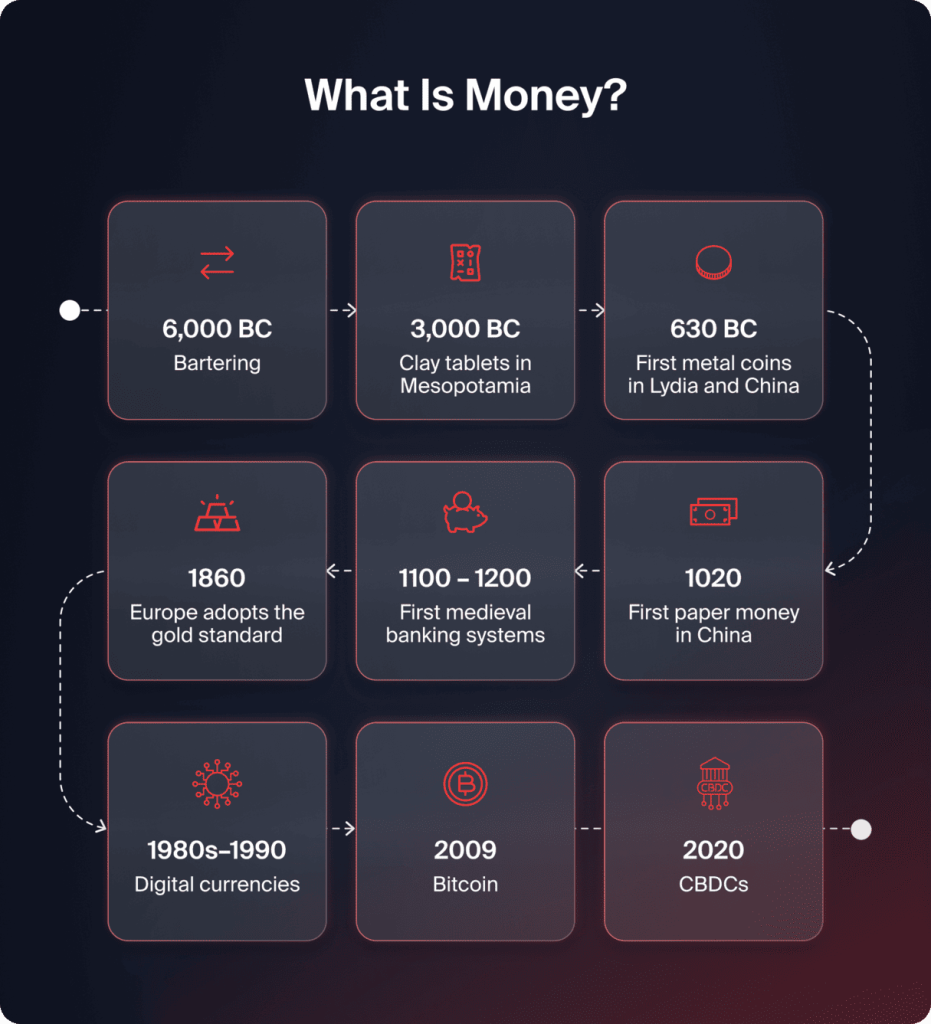
El dinero se refiere a cualquier medio de intercambio, unidad de cuenta o reserva de valor que sea generalmente aceptable. Se utiliza para comprar bienes y servicios, como unidad de cuenta para fijar precios y para almacenar valor.
1 Identifiable
People must recognize and verify it so acceptance is fast and fraud is harder.
2 Durable
It should survive many uses without falling apart or losing usefulness.
3 Divisible
Smaller units are needed so people can price and pay for a wide range of goods and services.
4 Portable
Easy to move across people and places — a key reason paper and digital forms gained ground.
5 Trusted
Value rests on collective belief that others will accept it tomorrow — for fiat and digital systems, institutions and rules reinforce that trust.
Para que algo sea efectivo como medio de intercambio, debe cumplir varias condiciones:
Mientras que la economía actual funciona principalmente a través de efectivo y dinero digital, otras formas de dinero, como las mercancías y el dinero representativo, se usaron en civilizaciones anteriores. Estos sistemas anteriores moldearon cómo funciona el dinero hoy en día e influenciaron la evolución de los marcos financieros y monetarios modernos.
Commodity money — scarce, useful items (gold, silver, salt, cattle) accepted in trade. Keeps value outside its monetary role, but can be bulky, hard to split cleanly, and costly to store.
Representative money — paper (or similar) redeemable for a commodity like gold. Easier to carry than bullion, but needs credible reserves and confidence in redemption; expensive for the issuer to maintain.
Fiat — not backed by a commodity; value from law, institutions, and public trust (USD, EUR, GBP, etc.). Flexible for policy, but vulnerable to inflation or loss of confidence if mismanaged.
Electronic / digital money — balances and card/mobile flows recorded in databases. Fast and convenient at scale, but depends on banks, networks, and security; outages and cyber risk matter.
Cryptocurrency — blockchain-based; no central issuer (e.g. Bitcoin, Ethereum). Fixed-supply designs can create scarcity, but prices are often volatile; regulation and custody risks vary globally.
CBDC — digital form of fiat issued by the central bank, legal tender like cash. Aims at efficient payments and inclusion; raises questions around privacy, bank intermediation, and design choices still being piloted worldwide.
Dinero Mercancía
El dinero mercancía es una de las formas más antiguas de dinero. Se refiere a objetos que tienen un valor intrínseco, que luego podrían usarse como sustitutos de bienes, ya sea que se utilicen o no como dinero. Las personas aceptaban estos objetos en el comercio porque eran útiles, escasos o deseados en gran medida dentro de una sociedad.
A lo largo de la historia, las comunidades utilizaron productos como el oro, la plata, la sal, el ganado, las conchas y los granos como formas de dinero. La popularidad del oro y la plata se debía a sus cualidades de durabilidad, divisibilidad y escasez, mientras que la atracción hacia la sal radicaba en su facilidad para conservar alimentos. Estos productos se utilizaron como dinero mucho antes de la existencia de los bancos.
Características Clave del Dinero Mercancía
Limitaciones del Dinero Mercancía
A pesar de que es tan importante, el dinero mercancía tiene algunas desventajas obvias.
A medida que el comercio aumentó en complejidad, estas características hicieron que el dinero mercancía fuera menos útil para los grandes mercados y los sistemas económicos modernos. Sin embargo, tales imperfecciones contribuyeron a la necesidad de formas de dinero más eficientes, como el dinero representativo y, más tarde, el dinero fiduciario.
Dinero Representativo
El dinero representativo es una forma de dinero que representa una mercancía física. En lugar de tener valor en sí mismo, es un reclamo a algo de valor que se puede canjear a demanda. En el pasado, este tipo de dinero permitió a las personas usar dinero en papel en lugar de llevar mercancías preciosas como oro o plata.
Con el sistema del patrón oro en funcionamiento, las personas que tenían dinero en papel podían intercambiar la moneda por una cierta cantidad de oro. Era más fácil realizar transacciones manteniendo el valor de la moneda, ya que todo el dinero estaba respaldado por un cierto activo tangible mantenido como reserva.
El dinero representativo fue una fase de transición importante entre el dinero basado en mercancías y el dinero fiduciario.
Características Clave del Dinero Representativo
Limitaciones del Dinero Representativo
A medida que las economías globales crecieron, la mayoría de las naciones abandonaron el dinero representativo a favor del sistema fiduciario, lo que permitió un mayor control monetario. Aunque ya no se utiliza de manera generalizada, el dinero representativo tuvo un papel fundamental en la creación de la banca moderna, las reservas y la política monetaria.
Dinero Fiat
El dinero fiduciario representa la forma de dinero más utilizada en la sociedad contemporánea. Se diferencia del dinero mercancía en que carece de valor intrínseco y no está respaldado por mercancías, incluyendo oro y/o plata. Su valor radica en la fortaleza de la autoridad emisora (gobierno), la confianza del público en la institución emisora y la economía en general.
Hoy en día, casi todos los países operan con un sistema de dinero fiduciario. Ejemplos comunes incluyen el dólar estadounidense (USD), el dólar canadiense (CAD), el euro (EUR) y la libra esterlina (GBP), etc.
Características Clave del Dinero Fiat
Limitaciones de la Moneda Fiat
A pesar de tales riesgos, la moneda fiduciaria ha permanecido como la columna vertebral de las economías alrededor del mundo debido a su eficiencia y adaptabilidad.
Dinero Electrónico
El dinero digital es completamente digital, sin representación física como monedas y efectivo. El dinero digital se almacena y se lleva utilizando plataformas digitales como bancos y mecanismos de pago en línea, incluidos aquellos en teléfonos inteligentes.
Hoy en día, la mayoría del dinero utilizado es digital. Los salarios pueden pagarse digitalmente, y las transacciones pueden realizarse de manera digital. Las compras pueden hacerse digitalmente o a través de tarjetas y dinero en efectivo digital. En agosto de 2025, el sistema UPI de India aumentó un 34% registrando 20 mil millones de transacciones en un solo mes, lo que destaca cómo el dinero digital está superando el uso del efectivo tradicional.
Ejemplos típicos de dinero digital incluyen el dinero encontrado en una cuenta bancaria, dinero en una tarjeta de débito o crédito, dinero móvil, así como dinero en servicios de pago en línea como PayPal, entre otros.
Características Clave del Dinero Digital
Limitaciones del Dinero Digital
A pesar de estos desafíos, las monedas digitales están en el corazón de las economías hoy en día, impulsando los pagos, las transacciones transfronterizas y un sistema financiero digital.
Criptomoneda
La criptomoneda es una moneda digital que funciona sin el control de los bancos centrales y los gobiernos. Utiliza una tecnología conocida como blockchain, una forma de libro mayor distribuido que almacena detalles de transacciones en una red de computadoras. Tal tecnología permite un sistema de consenso para el procesamiento de transacciones sin requerir un sistema de control central.
A partir de principios de 2025, aproximadamente 659 millones de personas, alrededor del 8.3% de la población global, poseen alguna forma de moneda digital. Además, la capitalización de mercado global de criptomonedas actual es de aproximadamente $3 billones a partir del 21 de diciembre de 2025. Este valor ha experimentado un crecimiento significativo en 2025, incluso brevemente superando los $4 billones en el tercer trimestre de 2025, reflejando un crecimiento significativo en la adopción.
Las criptomonedas más prominentes son Bitcoin, que fue diseñado como un reemplazo entre pares para la moneda tradicional, y Ethereum, que va más allá de los límites de meras transacciones para habilitar contratos inteligentes y otras aplicaciones.
Características Clave de las Criptomonedas
Limitaciones de las Criptomonedas
Sin embargo, el impacto de las criptomonedas no se ha visto afectado por estos desafíos, y continúa afectando el sistema financiero global.
Moneda Digital de Banco Central (CBDC)
Una Moneda Digital de Banco Central, a menudo referida como CBDC, es la forma digital de una moneda fiduciaria, y esta moneda fiduciaria es emitida por el banco central. Una CBDC es diferente de la criptomoneda ya que está respaldada por el gobierno, y tiene el mismo estatus que el dinero en papel. Sin embargo, las CBDC están ganando tracción global con más de 130 países explorando o pilotando CBDCs. Las proyecciones muestran que los volúmenes de transacciones podrían expandirse de 307 millones en 2024 a 7.8 mil millones para 2031.
Este aumento en los volúmenes de transacciones puede verse influenciado por su diseño para proporcionar un sistema de pago modernizado a los países. Este diseño se logra al combinar la velocidad y conveniencia del dinero digital con la estabilidad del dinero emitido por el banco central. Generalmente se emiten de manera electrónica y se utilizan para realizar pagos, transferir fondos y ahorrar dinero.
Estos incluyen, por ejemplo, el eNaira de Nigeria, una de las primeras CBDC minoristas completamente lanzadas, y proyectos piloto emprendidos por bancos centrales en regiones como Europa, Asia y las Américas.
Características Clave de las CBDCs
Rol y Futuro de las CBDCs
Los bancos centrales ven las CBDC como instrumentos para minimizar los costos de transacción y promover la transparencia. Las CBDC podrían convertirse en instrumentos para que los gobiernos aborden el lavado de dinero y aumenten la eficiencia de la asignación de fondos públicos.
No obstante, las CBDC también plantean ciertas preguntas con respecto a la privacidad, la seguridad de los datos y la participación de los bancos comerciales, y por lo tanto, un gran número de países aún se encuentran en la etapa de investigación y piloto.
Cómo difieren los principales tipos de dinero
Los tipos básicos de dinero se distinguen según el origen y el control del dinero, su forma y su estabilidad. Conocer estas distinciones es importante para comprender cómo más de un tipo de dinero puede coexistir dentro de la economía.
Fuente de Valor
Existen tipos de dinero cuyo valor proviene del valor intrínseco. El dinero mercancía, como el oro o la plata, obtiene su valor debido a sus propiedades. Sin embargo, otros tipos de dinero, como el dinero fiduciario y el CBDC, no provienen necesariamente de algo que tenga valor intrínseco. Una nueva clase incluye el dinero como Bitcoin, cuyo valor proviene de las fuerzas del mercado, los avances tecnológicos y la usabilidad.
Control y Emisión
El control sobre estas formas de dinero varía significativamente. Mientras que el dinero fiat y las CBDCs son impresos y controlados por el gobierno y los bancos centrales, las criptomonedas son descentralizadas, lo que significa que funcionan sin un control central. Sin embargo, utilizan un sistema distribuido para validar las transacciones.
Formulario y Accesibilidad
El dinero puede ser físico o digital. El dinero tradicional en forma de mercancía y el dinero fiduciario se pueden ver en forma física, ya sea en forma de monedas o billetes, mientras que el dinero digital, las criptomonedas y las CBDCs están en forma electrónica. Las formas electrónicas permiten transacciones rápidas y transacciones transfronterizas fluidas, pero dependen de la tecnología.
Estabilidad y Volatilidad
La estabilidad es otro aspecto importante en el que difieren los diferentes tipos de dinero. El dinero fiat y las CBDC están diseñados de tal manera que se logra la estabilidad en el poder adquisitivo. Sin embargo, el dinero mercancía puede tener fluctuaciones basadas en los mecanismos de oferta y demanda. Por otro lado, las criptomonedas son altamente propensas a la volatilidad.
Por qué es importante entender los diferentes tipos de dinero
El conocimiento sobre los tipos de dinero tiene muchas aplicaciones. No solo tiene una importancia teórica, sino que también resulta útil en el mundo real.
Conclusión
El dinero ha evolucionado de materias primas físicas a sistemas digitales complejos. Cada tipo de dinero existe para resolver problemas económicos específicos y mejorar la forma en que se intercambia y almacena el valor. Al comprender los principales tipos de dinero y cómo difieren, los individuos y las empresas pueden navegar mejor por el panorama financiero moderno y prepararse para futuros cambios en las finanzas globales.

