
A Bitcoin ETF gives you exposure to bitcoin through shares you can buy and sell in a brokerage account. A spot Bitcoin ETF holds bitcoin; a futures-based ETF uses contracts linked to its price. In both cases, you own shares in an investment product, not bitcoin in a personal wallet.
Here is how those shares get their value, why they can trade at a different price from their holdings, and which costs and risks matter. The examples below focus on U.S. products; structures and access differ in other markets.
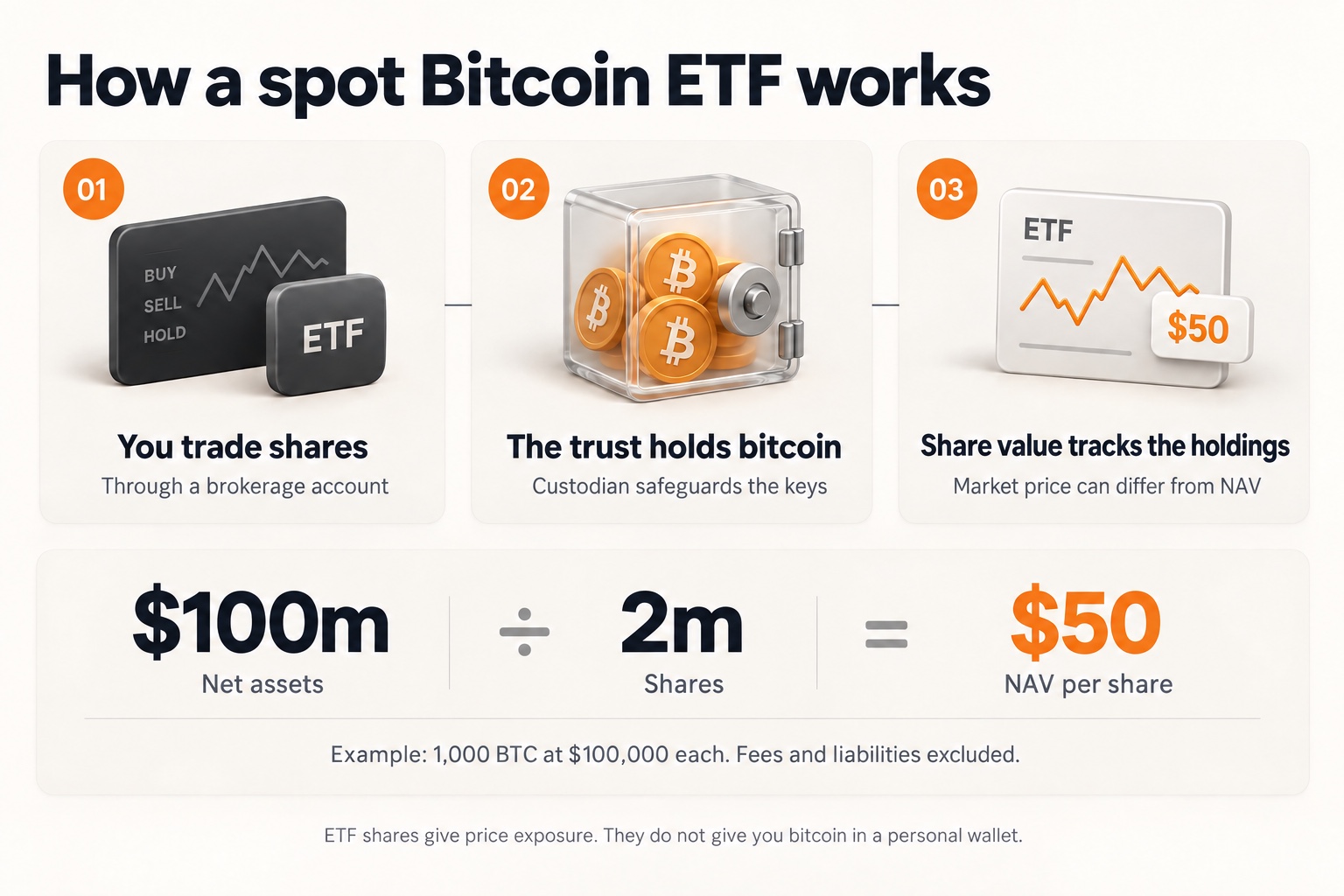
How Does a Spot Bitcoin ETF Work?
1. You buy and sell shares through a broker
You place an order using the product’s ticker, much as you would for a stock. U.S. examples include iShares Bitcoin Trust ETF (IBIT) and Fidelity Wise Origin Bitcoin Fund (FBTC).
Most retail trades take place between investors on the exchange. If you buy existing shares, your money goes to the seller through the trading and settlement system. Your purchase does not automatically trigger a new bitcoin purchase by the trust.
2. The trust holds bitcoin through a custodian
The trust holds bitcoin for shareholders, and its custodian safeguards the private keys under the applicable agreements. Your shares represent an interest in the trust’s net assets. You get price exposure without setting up a wallet, but you cannot use those shares to make a Bitcoin payment.
The custody arrangements still matter: service providers, security procedures and insurance limits vary by product. Using an ETF changes who manages custody; it does not eliminate custody risk.
3. Institutions can create and redeem shares
Authorized participants, or APs, are institutions with agreements to transact directly with the product in large blocks called baskets. They can add shares through creation or remove them through redemption.
Depending on the product’s terms, this uses cash or bitcoin. In a cash creation, cash is delivered and bitcoin is purchased under the trust’s arrangements. In an in-kind creation, bitcoin is delivered in exchange for new shares. Redemption reverses the process.
The SEC permitted in-kind creations and redemptions for crypto ETPs in July 2025. That did not create a retail withdrawal service: ordinary investors still normally exit by selling their shares through a broker. The IBIT prospectus, for example, reserves basket redemptions for authorized participants.
4. This process helps shares follow bitcoin’s value
Net asset value (NAV) per share is the value of the product’s assets, minus liabilities, divided by its shares outstanding. The exchange price is what buyers and sellers agree to pay. These values can differ.
Suppose the assets behind a share are worth $50, but shares trade at $51. An AP may be able to create shares at a cost close to their underlying value and sell them at the higher market price. If the difference exceeds its costs, it can earn a profit. The extra supply can help bring the share price back toward $50.
When shares trade below their underlying value, buying and redeeming baskets can work in the opposite direction. This is the creation-and-redemption mechanism. It helps prices stay aligned, but does not guarantee a perfect match. A published daily NAV is also a valuation at a particular time, not a live trading quote.
A Simple Bitcoin ETF Example
Imagine a spot trust holds 1,000 bitcoin valued at $100,000 each and has 2 million shares outstanding. Ignoring cash, fees and liabilities:
$100 million in assets ÷ 2 million shares = $50 NAV per share.
Each share represents exposure to roughly 0.0005 bitcoin. Buying 20 shares at $50 costs $1,000 before trading costs and provides exposure equivalent to about 0.01 bitcoin.
If bitcoin rises 10%, NAV would rise to $55, assuming the holdings and share count stay unchanged. If bitcoin falls 20%, NAV would fall to $40. Your actual return also depends on fees and the market price when you buy and sell.
These numbers are illustrative. One ETF share is not one bitcoin, and a lower share price does not mean a product charges lower fees.
Spot vs. Futures Bitcoin ETFs
A spot product holds bitcoin. A futures-based ETF gets exposure through derivatives, with collateral and other assets as its strategy permits. For example, ProShares Bitcoin ETF (BITO) uses futures and swaps and does not invest directly in bitcoin.
Futures expire, so a fund generally replaces contracts to maintain exposure. This is called rolling. Buying the next contract can cost more or less than selling the expiring one, affecting returns. Futures pricing, rolling, collateral income and fees can all make performance differ from the spot bitcoin price.
Futures exposure is not automatically leveraged. Products targeting 2x or inverse daily returns are separate strategies. Because of daily resets and compounding, a 2x daily ETF does not necessarily deliver twice bitcoin’s return over a month or year; the SEC explains this distinction.
Bitcoin ETF vs. Buying Bitcoin Directly
| Feature | Spot Bitcoin ETF / ETP | Bitcoin in your own wallet |
|---|---|---|
| What you hold | Shares representing an interest in a trust’s net assets | Bitcoin controlled through your private keys |
| Custody | The trust’s appointed service providers manage custody | You manage private keys, backups and transfers |
| Transfers | Shares cannot be sent as bitcoin or spent on the Bitcoin network | Bitcoin can be sent to another compatible address |
| Trading access | Depends on your exchange and broker’s supported sessions | Crypto markets generally operate around the clock, subject to service availability |
| Costs | Ongoing product fee, spread and any broker or currency-conversion charges | Trading spreads, exchange and network fees, plus any custody costs |
Both choices leave you exposed to bitcoin’s price. Buying through a custodial crypto platform is also different from holding bitcoin in a wallet whose keys you control.
What Does a Bitcoin ETF Cost?
A product can be commission-free to trade and still cost money to hold. Check:
- Ongoing fee: the sponsor fee or expense ratio reduces the product’s assets and returns.
- Bid-ask spread: the gap between the prices available to buyers and sellers.
- Broker charges: any commission, account fee or currency-conversion cost.
- Strategy costs: portfolio transactions and futures rolling can affect performance beyond the headline fee.
For scale, a hypothetical 0.25% annual fee on a constant $10,000 investment is about $25 a year. Actual amounts depend on changing asset values and how long you hold the shares. Check whether an advertised rate includes a temporary waiver.
Some spot trusts sell or transfer bitcoin to pay expenses. This gradually reduces the bitcoin represented by each share, as described in the IBIT fact sheet, and can cause returns to lag the bitcoin benchmark.
Benefits and Risks to Understand
The main benefit is familiar access: a securities account, ordinary trade orders and consolidated portfolio reporting. Eligible products may also be available in retirement or other investment accounts, depending on the provider and local rules.
The main risks remain:
- Price volatility: bitcoin can fall sharply. Holding one cryptocurrency through an ETF does not create a diversified portfolio.
- Custody and operations: security incidents or problems at service providers can affect the investment.
- Trading gaps: bitcoin can move while your ETF trading venue is closed, causing shares to reopen at a different price.
- Tracking and liquidity: fees, spreads, premiums and discounts can make your return differ from a bitcoin price chart.
Regulation does not insure your investment against losses. U.S. SIPC protection concerns eligible missing cash and securities when a member brokerage fails; it does not cover a fall in the ETF’s market value.
What to Check Before Choosing a Product
Read the issuer’s current disclosures for the strategy, benchmark, total costs, custody arrangements and trading liquidity. Compare total returns over the same dates, including distributions. A fund’s cash payout is not extra profit on top of an unchanged share price.
Check legal and tax treatment too. U.S. spot Bitcoin products are generally commodity trusts, a type of exchange-traded product, rather than investment companies registered under the Investment Company Act of 1940. The SEC’s investor bulletin explains the different protections.
Tax rules depend on the product, account and jurisdiction. For example, IBIT’s U.S. tax disclosures explain that bitcoin sales or transfers to pay expenses can create taxable gains or losses for shareholders without a cash distribution. Do not assume tax only arises when you sell your shares.
Takeaway
A Bitcoin ETF puts bitcoin exposure into a security you can trade through a broker. Understand what it holds, how its shares follow those holdings, and what fees reduce your return. A spot product simplifies access and custody, while leaving bitcoin’s price risk firmly in place.

